


MagenticBrain

MagenticBrain is an orchestration model from Microsoft Research AI Frontiers, built as the brain of the MagenticLite agent stack — a planner, coder, and delegator in one. Fine‑tuned on Qwen 3 14B, it turns vague natural-language requests into concrete plans, picks the right tool or sub‑agent for each step, writes code when code is the right answer, and recovers when something breaks mid‑task. Critically, it was trained end‑to‑end within the MagenticLite harness itself, with the same tool schemas and execution environment it sees at inference time — so there’s no gap between how it learned to orchestrate and how it actually runs. Put simply, it’s a small model doing the job of a big one.
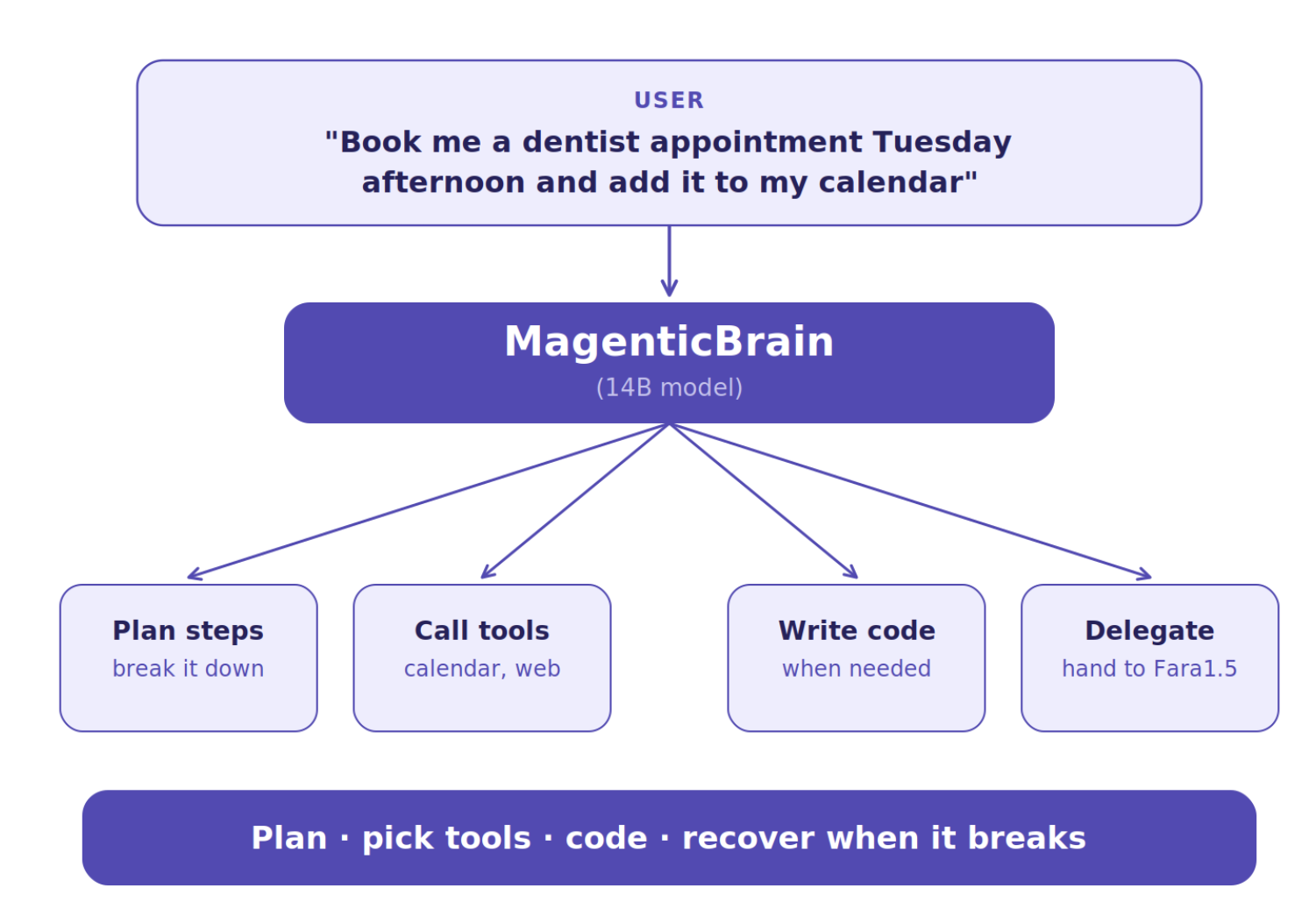
MagenticBrain is built for builders pushing agentic systems to small‑model footprints — multi‑agent applications, on‑device assistants, and anywhere reasoning has to be fast and cheap. Two design choices make this possible at 8B: trajectories that blend tool‑calling with coding and terminal sequences, and explicit delegation training that teaches the orchestrator when to hand off browser work to a specialist computer‑use model like Fara1.5. The result is an orchestrator that reasons, codes, calls tools, and delegates fluidly inside a single 8B footprint — one you can drop into MagenticLite or compose into your own stack.